
• Unit-level profitability from day one
• 60% gross margins, expandable to 93% at scale
• LTV:CAC > 15:1, placing us in the top tier of venture-scale efficiency
• Average 30% month-over-month growth YTD, with accelerating demand
• Net Promoter Score = 100 from the first 75 paying patients
• Category validation: 30:1 preference for Native-AI Community Eye Care
• New category of care offers Partner FQHCs revenue w/30-40% margins
Introduction
In January 2025 alone, AI startups raised $2.2 billion from venture capital across 50 deals, each jockeying their solution to the badly ailing US healthcare industry. HDai is entering this highly competitive arena with our breakthrough solution: the Native AI Encounter Platform.
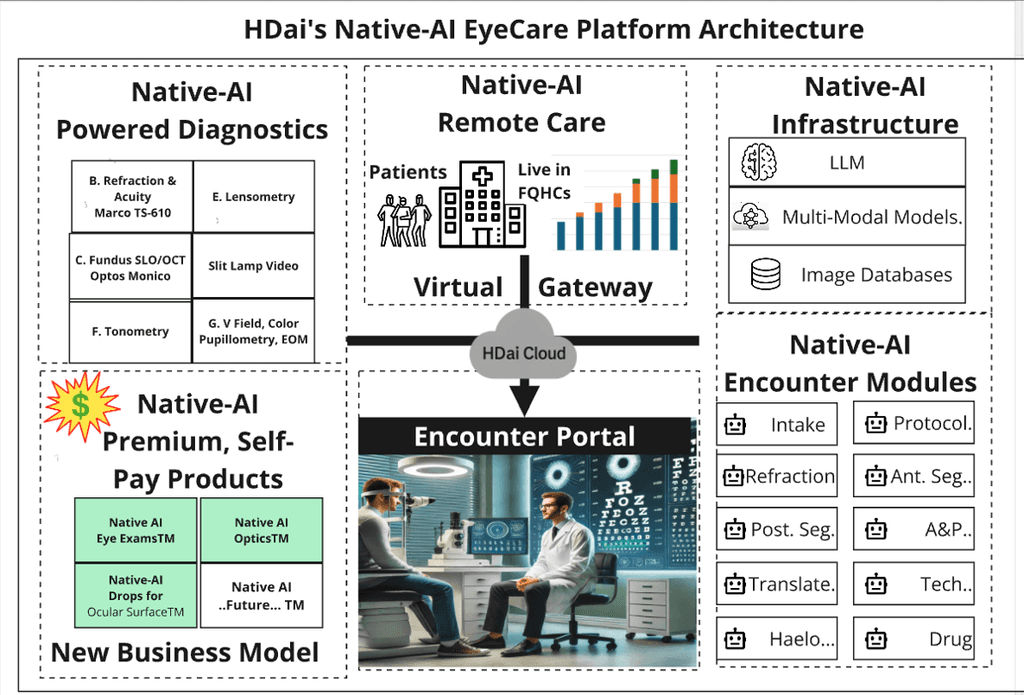
HDai’s Platform completely re-engineers the doctor-patient encounter—healthcare’s core value-creating transaction—by digitizing every process and embedding AI, intelligent agents, and automation from start to finish.
And it’s Already Working.
HDai’s first deployment is a tightly focused wedge into the underserved FQHC market: delivering a new category of Native-AI Community Eyecare™ to underserved patients at risk for sight-threatening disease who lack access to specialty care. And the results are astounding:
These are not projections. They are in-market results from real customers, real patients, real doctors, and real revenue. They confirm that Native-AI Care isn’t just viable — it’s working. It’s profitable. And it’s already defining a new category of healthcare built around physician-empowering AI.
HDai isn’t just launching a platform. We’re leading the emergence of Native-AI Healthcare — a new super-category and future standard of care for the AI age.
Strategic Insights: Three Decades of Domain Expertise, Two Startups, and Five Books
To understand how we got here—and why we believe HDai is poised to define the next great healthcare category—you need to understand the journey. What follows is a first-principles account of how 30+ years in outpatient care, two VC-backed startups, and five seminal books on innovation shaped HDai’s strategy. This is also a tribute to the authors whose ideas we’ve put into practice to build something rare: a category-defining company with metrics to match.
In HDai’s Point of View, I describe the US healthcare system as a $1 trillion mess—and outline our vision to fix it with a new category: Native-AI Healthcare. This category is designed to transform outpatient care by simultaneously solving its four intractable problems: rising costs, inconsistent quality, limited access, and plummeting physician income—forces that threaten the continued viability of healthcare delivery.
I’ve had a successful career spanning over three decades as an ophthalmologist, with experience across academic, research, and private practice settings. My professional and entrepreneurial journey began with a disruptive technology: the 193 nm excimer laser, which revolutionized eye surgery with the procedures we know today as LASIK and PRK.
In my early days as an ophthalmology resident in Miami—nearly a decade before the laser was approved by the FDA—I loaded rabbits into my Toyota hatchback and hauled them across Rickenbacker Causeway to UM’s Oceanography Center, where we zapped their eyes with the magical far-UV laser to see if it could remove corneal scars (it did).
As an ophthalmology research fellow at Emory in Atlanta, I progressed to Rhesus monkeys, using the excimer laser to reshape their corneas to determine whether it could correct nearsightedness without causing scars (it could).
Later, as a Professor of Ophthalmology at Emory, my colleagues and I led FDA clinical trials of the new laser on human subjects. We studied a novel variation of the surgery known as LASIK—reshaping the cornea beneath a flap—which accelerated visual recovery and improved outcomes. In 1997, our Emory team presented the first LASIK clinical trial results to the FDA, making a significant contribution to understanding the procedure’s safety and efficacy, and teaching our techniques to eye surgeons around the world.
The LASIK Lesson: First-Mover ≠ Durable Advantage
Years before the authors of Play Bigger coined the concept of category design, I witnessed firsthand how a breakthrough technology birthed a new multi-billion-dollar category: laser vision surgery. As first movers and leaders in the category, my co-founders and I generated years of highly profitable growth and delivered a successful exit for our VCs and other investors.
But over time, I learned the hard truths of category dynamics: even the most promising new market will mature, commoditize, and—surprisingly quickly—decline. Our laser center business lacked the strategic foundations necessary for long-term durability—principles later articulated eloquently by Hamilton Helmer in 7 Powers.
While the LASIK journey taught me the limitations of first-mover advantage and the perils of commoditization, my second startup, DigitalVision, served up different lessons. From Georgia Tech’s incubator—my co-founder and I launched the VisionOptimizer, a modern electro-optical device designed to replace the century-old phoropter: the bulky stack of dials that eye doctors place in front of patients while repeatedly asking, ‘Which is better, one or two?’
While our critique of the phoropter as a relic was accurate, our innovation neither solved a pressing industry problem nor harnessed a strong external inflection—two elements legendary seed investor Mike Maples Jr., co-founder of Floodgate and author of Pattern Breakers, identifies as essential. Maples argues that great startups don’t just build better products—they ride powerful waves of change to uniquely offer something customers are desperate for. We didn’t.
We also lacked the disciplined go-to-market strategy that Steve Blank outlined in his landmark book The Four Steps to the Epiphany—the work that launched the Lean Startup movement and introduced a structured approach to customer discovery, validation, and acquisition. Instead, our VisionOptimizer escaped from the lab in a futile search for a market. Had I read Mike and Steve’s books, we might have avoided the loss of several million dollars of investor capital and six years of our team’s time.
Harvey for Healthcare
Legal-AI startup Harvey showed the world what happens when AI is used to reinvent how work is done in a legacy profession. By reimagining the legal brief with generative AI, Harvey scaled from zero to $75M in ARR over 2 years and completed a successful $300M series D raise at a $5 billion valuation in May 2025. Harvey's rise has validated a new model: Vertical AI platforms, led by domain experts, can unlock enormous value by rebuilding professional workflows from the ground up.
HDai is applying that same playbook to a far larger and more dysfunctional market—healthcare. But instead of rebuilding legal briefs, we’re rebuilding the doctor-patient encounter: the core value-creating transaction of a $1 trillion industry.
Like all category-defining companies, HDai is building in what is today a $0B market — Native-AI Healthcare doesn’t yet exist. But just as Salesforce made SaaS CRM inevitable, and Harvey is redefining legal workflow, HDai is doing the same for the doctor-patient encounter. We’re not fighting for scraps in a crowded space; we’re defining the next frontier of care.
Harnessing Career Lessons into HDai’s Strategy to Fix Healthcare
Today, the phenomenal potential of AI offers entrepreneurs a once-in-a-lifetime opportunity to reinvent healthcare and solve its intractable problems. The conditions for a platform shift are imminent—AI is redefining what’s possible, and a new category king will emerge to tip the market. HDai is positioned to lead that change—and the window to create Native-AI Healthcare is now.
The strategic framework that guides HDai’s Native-AI strategy is grounded in three decades of domain expertise, two startup journeys, and insights from five seminal books on innovation. The authors' page has links to the key ideas from these sources that have been incorporated into HDai's strategies to build and dominate the new category of Native-AI Healthcare.
From Lasering Rabbits to Fixing Healthcare
How a Founder’s Lessons Shaped the Strategy for Native-AI Healthcare